Showing posts with label sufi. Show all posts

Monday, April 28, 2014

Rewriting Delhi - Part I

Around December last year, I began assisting Asif Khan Dehlvi in his endeavour named Delhi Karavan, which is a concept traversing through time and space to serve the best of Delhi in front of those who are in love with the city, and are eager to explore it. In my journey with Delhi Karavan, I realized the truth in the oft quoted line - To have travelled is to have arrived. I am more of a ghostly presence there, seldom manifesting in actual events, but lurking somewhere behind the online face of it. The freedom which Asif grants me to explore my city, my way, is what makes even this virtual journey so liberating, and in keeping with the same spirit, I started drafting for Delhi Karavan mini Facebook columns called 'Rewriting Delhi' sometime back. These columns were about how I saw my city, and what is it that fascinated me about it. In the form of stale quintets, I decided to share these columns with you as well, also to know what is it about this rich, ravaged, reconstructed city that you happen to admire.

Here is the first quintet, the first five posts written under #RewritingDelhi 

#1

"Meri muhabbat pe shaq na kar ae sheher mere
Par teri dewaaron par laparwaah si kabhi sachchai bhi dikh jaati hai"

Armed with a new phone in hand, with awesome camera specification, I was eager to click the best visuals from my city - and this is the first that caught my eye in a fast food outlet in Connaught Place. It amused me, yes, but also shook up some funny memories of misogynistic encounters I have had while travelling through the deemed safest areas of Delhi. I love this place I live in, and this is where I want to die - but our city has to go a long way in becoming a safer haven for women. Or so I think.

Some people, I reckon, need to read the writing on the wall.

Spotted inside McDonald's, somewhere in CP

#2

"Panno mein uljhe chehron ko dekha hai kya kabhi?
Tujhmein hi ae sheher yeh apna khwaab sajaate hain"

This lane has a distinctive importance of its own - if you ask me, then more so. This is where the dreams of many an aspirants for the highest jobs in India come to seek salvation. Not just that, this is where an entirely different kind of crowd scurries in as well - and that is the foodie crowd. If you are a chaat-deewaana, it can't be that you have not heard of the Shri Prabhu Chaat Bhandaar in Delhi. Just in case you have not, you must rush here to see the confluence of some serious aspirations with some tangy flavours.
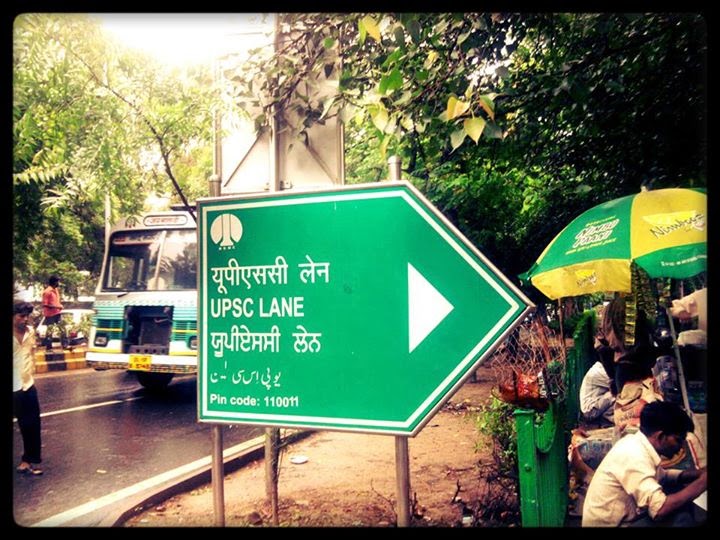
Right beside Dholpur House, the destination for many aspirations


#3

The excitement of devouring these lovely, fried pieces of potato was such that I could not avoid getting the click blurred. But then, that is what #DelhiChaat does to you. Invariably, in all corners of the city, around the next bend, at short distances from each other, you will find jazzy chaat stalls inviting you with all their might to taste the sweet and tangy flavours they have to offer. Golgappas, Tikki, Lachchha Tokri and a spread of some other delectable quick-foods is irresistible. For me, however, these fried potatoes - called Aaloo Chaat - work best. Is it the same for you too?

This is proper Delhi fast food, which no number of Americanised joints can push out. And thats what I will keep believing.

Aloo Chat!


#4

“Kya manzil ki tak mein zindagi basar karoon
Ya is safar ko hi apni manzil maan loon?"

Have you ever felt like taking a taxi to nowhere, to travel for the sheer pleasure of travelling? This picture, by my dear friend, Aaqib Raza Khan gives me dreams, it makes me want to become an explorer. A taxi to nowhere could also be a taxi to everywhere, or so I think.

I don't see many taxis around in the city, except now for those fancy call-cabs, each an advertisement hoarding in itself. But then, this is also how my city is changing, evolving, becoming new.

Aaqib Raza Khan's lens clicks these beauties!

#5

"Ae sheher tu razdaar bhi, dildaar bhi, fankaar bhi
Jo panaah de, na sawaal kare, woh humsafar, woh yaar bhi"

You did not think this city opens its arms only for you, is it? When you head out to capture interesting moments, you find them being played out between creatures of all colours and sizes. Like here. These were spotted lurking on top of a shed in some corner of Dargah Nizamuddin Auliya, caught deftly by the all observing camera of Aaqib.


Are they growling, or romancing? That is where my thoughts end, still wondering.

Inside Dargah Nizamuddin Aulia, again clicked by Aaqib
PS - If you liked what you got to read here, more will come your way, soon!
Meanwhile, why don't you follow @DelhiKaravan on Twitter, or hop onto their Facebook page by clicking here.

Tuesday, April 8, 2014

Ammi - Letters to a Democratic Mother by Saeed Akhtar Mirza


That is why I came down to your bed that night and began to massage your feet. Do you remember? ‘That’s very nice of you Saddu … very nice,’ you had said as I kneaded your feet and ankles. I know you were surprised by my action but what I didn’t tell you was that I was hedging my bets. You had once told me that it was written in the Quran that heaven lay at the feet of all mothers. As I massaged your feet furiously, I was hoping God was watching and taking down notes. (Page 66, Ammi- Letters To A Democratic Mothers, Saeed Mirza)

The concept of motherhood is perhaps the simplest to understand. It is universal. No man can eschew its influence, both, in the presence and absence of a mother. Despite being simple and universal, the intricacies of motherhood are complex to the observer’s eyes; unfathomable too. Thoughts, theories and eulogies exist aplenty about it all - the most apt perhaps being the one which equates mother to God- the Creator. The divinity, the unquestionable haloed status of a mother arises from the fact that she is the channel through which new, nascent life forms set foot in the world. She seamlessly glides into the role of a Preserver too, as she nurtures and protects her infant, and oversees his/her growth into an able, and healthy adult. Truly has been said about this unsung hero who decorates each child’s life with beauty and comfort that she is not someone to be understood from the outside. Only a mother can understand the dynamics of a mother’s heart. She is the most powerful influence in the early stages of a man’s life, but not always understood by the very objects of her love. The time when she is, is sometimes too late.


On the surface, the debut novel of Saeed Akhtar Mirza, seems to be building on this lamentation associated with motherhood. Below the surface, the same novel derives heavily from a psychedelic mix of unrelated concepts, thoughts, ideas and people to form a narrative which is engaging and unconventional. Ammi- Letters to a Democratic Mother is a unique book. At its core lies a son’s awe, admiration and reverence for his mother. However, the book seeks to investigate more than just the relationship between a child and his mother. This book is a journey across time and space, events and people which influenced a young mind. This book is also a sensitive, yet not sentimentally, written ode of a child to his mother, posthumously.

Saeed Akhtar Mirza – the name may be new to the world of contemporary Indian literature, but it is very popular among art cinema aficionados. After a decade of bollywood inspired by the angry young man in whom the discontent of the middle class found voice, 1980s were a decade of creative degeneration, as is rued in polemical accounts by cinema critics. The 1980s, also called the ‘disco’ decade, were also the decade in which the Indian art cinema scene came of age. Serious in content and keenly intent upon telling realistic stories inspired from sociopolitical climate of the times, this wave of cinema was endorsed and led by acclaimed film-makers foremost among whom was Saeed Akhtar Mirza. By making and presenting films like Naseem, Mohan Joshi Hazir Ho, Saleem Langde Pe Mat Ro and Albert Pinto Ko Gussa Kyun Aata Hai to an audience blinded by the glitz and glamour of mainstream cinema, Mirza had long established himself as a master storyteller. This time around too, he comes out to tell a story, story within stories, only using a slightly different medium. He holds a pen in his hand instead of a camera, and churns out a novel which delights with its understanding of important concepts and world events.

Mirza’s mother passed away in 1990. Despite being in the same city, Mirza could not meet his mother before her death due to a mundane act of procrastination. This novel was penned around 2007 in the form of a long, continuous letter written posthumously by Mirza to his mother. Despite this lucid proclamation, this novel is cannot be categorized under the routine epistolary form of writing. In his narrative, Mirza mixes together more than half a dozen literary forms to aid the narrative as and when required. Ranging from critical reporting of global and domestic events, parables, poetries (Urdu and English), short stories, historical accounts, travelogue, to satires and plain sharing of memories- this novel keeps changing the landscape a reader journeys on while reading it. Quite remarkably, experimenting with different literary genres does not, even for once, compromise upon the continuity and comprehensibility of the broad storyline. The essence remains constant; it is aided by scores of vignettes inserted at appropriate places to make the narrative engaging and entertaining.
The author - Saeed Akhtar Mirza

It is quite difficult to succinctly put into words the basic storyline, or what one would call the essence  of this novel. It has many stories to tell, many events to discuss and many discourses to give. However, broadly, in the form of a single letter, Mirza relates to the reader the domestic affairs of an ordinary Indian family. He begins with salutations to his mother and then goes onto build her personality, one that was formidable and inspirational from where he saw the world. He begins her story from the time of her marriage, and with sensitivity and sensibility, tracks her growth into a mature woman, who despite having begun her life in a cocoon, stands up as the moral, spiritual and even financial pillar for her family. A character analysis, albeit interesting, will take up a lot of space here, but suffice to say that it is a bildungsroman of a kind, in which many characters grow, and mature around the central, pervasive figure of the mother. At the end of the main narrative, the script of a film comes attached - which merits an entire review and analysis for itself. The magic of the book has many manifestaions - insight on love and relationship, history and politics, society and culture, individual and family - and so much more! 

That said, I have to emphasize that this book is compilation of rare beauties, which kept me enamoured from the first word. The most beautiful and believable love story unlocked itself in the pages of this book, almost like a fable of coming together, and staying together. It is a book I hold dear, very dear. It made me smile internally, it prompted me to think and reflect, it also motivated me to investigate into incidents and people mentioned. What more can a literary creation aspire for? Certain pieces of beauty should not be rated, but if I could, I would give it five stars on five, and perhaps some more.


Book Details - 
Author - Saeed Mirza
Publisher - Tranquebar
Published - 2008
Genre - Fiction
Pages - 385
Price - Rs. 295 (Paperback)

Friday, April 19, 2013

The Assassin's Song by M. G. Vassanji


Where should the bird fly after the last sky – Mahmoud Darwish


M. G. Vassanji is a known name in the genre of postcolonial writings who has dealt with demanding affiliations that manifest themselves at emotional, cultural, ethnic, linguistic, or political levels. In The Assassin’s Song, he places his protagonist in the context of harrowing identity investigation and a constant flux of experiences and values. As a Canadian writer with roots in what the West chooses to call the Third World, one notices in Vassanji’s works a striking preoccupation with shifting boundaries, his protagonist caught in the in-between world, and confused at the very premise of what to assert his belongingness to. In this quest, his narratives plunge into an investigation of the past, because it is from those nether lands of time that one snatches elements to complete the mosaic of his identity.


One way to look at The Assassin’s Song is as a bildungsroman narrative. It is essentially the story of Karsan Dargawalla, so is the son to the guardian of a Sufi shrine in Gujarat, called Pirbag, and is also its heir apparent. He is poised to take over his father’s role as ‘Saheb’ or ‘Lord’ of the shrine. The story traces Karsan’s struggle to come to terms with this pre-ordained fate of his. Like any other child, he has his interest zones – cricket being mentioned as one. However, the words of Providence come sealed in iron for him, and he is forced into reconciliation with his future as the Saheb, also in the face of a difficult relationship with his distant father. Karsan breaks free from his restricted, stifled existence at Pirbag when he receives an offer to study at Harvard.

Karsan finds himself enjoying the new life in a new land, where he is given a greater chance to discover himself, his interests. It is also in this new life that he develops a different and closer relationship with his father through numerous epistolary exchanges. He discusses Keats with his father, who sends caveats enclosed in envelopes for him. In a sense, it makes one feel, as if the son is trying to expose to his father the vast expanse of unexplored land around, and the father is trying to rein the child within the secular, secure and sacred confines of the domestic space.

Karsan emerges in the novel as the figure of a wanderer – much like Nur Fazal, his divine ancestor was. Also in the wandering spirit, one can see the autobiographical imprints of Vassanji, who has also located and relocated, from Kenya, finally living in Toronto. In the image of Karsan, thus, one can see the personal conflicts faced by most native as well as diasporic members of postcolonial societies. Thus, woven into the fabric of Karsan’s personal struggles for identity are universal echoes emerging from postcolonial sites.


Among other things, The Assassin’s Song is about the danger of taking a neutral position in a world that demands certainties. The faith followed by Karsan’s family, the keepers of the Pir’s flame, is neither Hindu nor Muslim, but this doesn’t count for much in the heat of communal riots, when convenient labels have to be put on everything. The Assassin’s Song, in more ways than one, comes out as a novel which is fiercely secular, but not secular in isolation. What the novel does beautifully is to problematize the neutrality of someone who does not align himself to any one religion. The narrative puts to test the idealism ensconced in the notion of secularism by holding it as a source of conflict in the mind of Karsan when it comes to surviving in a world so vehemently bent upon demarcating itself into cocoons of narrow sectarian identities. Vassanji, an Ismaili Muslim, here draws on his own experience of belonging to a small religious community.


This bildungsroman story culminates in Karsan’s return. He comes back to that very place, and perhaps that very fate which he had desired so much to evade. In a sense, the novel reveals that all freedom is illusory. Even while travelling beyond his native realms, he was, somewhere deep down, the heir of Pirbag, the one entrusted to carry forward the secular legacy of Nur Fazal. After the devastation wrecked by clash of faiths, Karsan returns to his domain – the place which was his – and it is with ease peppered with slight anxiety that he takes on the role of the next Sahab of the shrine.

In this end, Vassanji doesn't tell us what to believe; he merely shows us the various stages of a person's exploration of self. At the conclusion, though the prodigal son returns, there is no sense of finality that a reader may get after journeying through various geographical and psychological terrains with Karsan. It can perhaps be said that exploration of self is a continuous process. Identity evolves with experiences. It is not to be found at the place of one’s beginnings, but can often be located in a faraway land, where distances come to signify affiliations in a stronger manner. Often, identity demands acceptance. Karsan’s moment of greatest disillusionment came, perhaps, when he discovered that the eternal lamp illuminating Nur Fazal’s dargah was not a manifestation of miracles, but a fraud of sorts in which his mother was complicit. But later, Karsan understands the necessity of miracles to sustain faith. To conclude, a quote from the first chapter would be apt, where words and sentences combine to give a sense of what form would Karsan’s quest for identity acquire as the novel proceeds.
“That is the important question I had to learn. What lies beyond the sky? What do you see when you remove this dark speckled blanket covering our heads? Nothing? But what is nothing?”
The author

Verdict? Very strongly recommended. Never did this before, but this novel takes 5 on 5 stars. 

(The above article is an exerpt from a paper I wrote in college, as a part of my course on Postcolonial Literature)


Monday, December 10, 2012

Divinity In Motion

“Maati ke tum deeware, jo suno hamaari baat,
 Aaj milawara piya ka, ve main jagiyoon saari raat.”

Have you ever had the good fortune of listening to voices steeped in divine fervour, belting out melody after melody, addressed to the Creator? Have you ever felt a part of the stupor which overtakes a throng which sits around the tomb of some saint as love-filled songs reverberate through the surroundings? Have you ever heard the music, the mere aura of which leads you to the Divine?

If any of the above sentences can be answered in a ‘yes’, you, in my opinion, have tasted music at its sublime best. As a generic statement, it can be surmised about music, that Great Music is such which makes you transcend your immediate environment, and elevates you to a level where you feel one with the Divine. It may also be stated specifically, that there is a kind of music which exists for the purpose of calling out to the Creator, and establishing an irrevocable bond of pious love with him. That music is what is known as Sufi music to all of us.

Delhi, labelled alternately as the city of romance, food, heritage and much else, is also the city which played home to many a sufi peers. It was Khwaja Qutbuddin Bakhtiar Kaki, a scholar of the Chishti Silsila (order), who brought Sufism to Delhi. However, it was Hazrat Nizam-ud-din Auliya and his disciple, Hazrat Amir Khusrau, who lent that shape to Sufi tradition in Delhi which we recognize today. Who among as has remained untouched by the magical spirit behind the song ‘Kun Faya Kun’, sung unto celestial perfection by the new age sensation – Mohit Chauhan and Javed Ali? That song, was, obviously, a rendition to the venerable peer, Sultan-ul-Mashaikh Nizam-ud-din Auliya. If that is one song which has left you touched and inspired, you will find celestial magic in the live qawwalis which echo in the precincts of Auliya’s dargah.

Kun Faya Kun is not Bollywood’s first experimentation with the sufi genre. It was Nusrat Fateh Ali Khan’s qawwaalis, iconic when played in the background of a couple’s courtship, which elevated a mundane love narration to something above the ordinary. The very forgettable debut of Aishwarya Rai in Aur Pyaar Ho Gaya was made memorable only because of the genius of Nusrat Fateh Ali Khan, who lent his voice and compositions to make soul-touching music. Qawwali is one of the most popular forms of sufi music, argued to have its origins in Persia. It was the 13th century saint, Hazrat Amir Khusrau Dehlevi, who is believed to have introduced this form of music to India. Khusrau, of course, is the genius also credited with significant contributions in Hindustani classical (vocal and instrumental) music. The orthodox Islam sees music, as other means of entertainment, with contempt. However, in Sufi tradition, which lays down the path of ecstatic union with God, music, as well as dancing, is an intrinsic part of treading on that path. Remember the Dancing Dervishes, anyone?

Sample the following lines sung at the beginning of a popular qawwali, Allah Hoo, by Nusrat Fateh Ali Khan –

“Tere hi naam se har ibtida hai
Tere hi naam tak har intiha hai
Teri Hamd-o-sana, alham do lillah,
Ke tu mere Muhammad ka Khuda hai”

The above lines are what is known as a ‘hamd’. A hamd is type of qawwali which is sung in praise of Allah. A Naat is one which sings praises of Prophet Muhammad (SAW). There are other types as well, primarily categorised on the basis of the object of devotion and the basic essence carried in the lyrics. However, you need not know any of these technicalities in order to enjoy the radiance of sufi music. The traditions date back some 700 years, and the Indian subcontinent is rich with variegated varieties of sufi music. The Sabri brothers and the Wadali brothers are my personal favorites, especially when they use their rustic voice to give a melody to Bulleh Shah’s lyrics. Bulleh Shah, along with Amir Khusrau, is arguably India’s most popular sufi poet. However, had it not been for the singers and composers, a large chunk of their poetry would have never come in contact with the ordinary populace.

Sufism is described as that mystic part of Islam, which emphasises on love, tolerance and harmony, and in which, the sole objective of existence is to come closer and closer to the Lord, such that you feel Him in you, and yourself in Him. A simple trip to any dargah, that of Moinuddin Chishti, Haji Ali, Salim Chishti, or Auliya himself, would make you realize, however, that the devotees which throng them are nothing but a picture of secularism. The ideals of peace and devotion preached in Sufism transcend all communal barriers and are hence, as appealing to Hindus as to their Muslim brethrens. When we understand this basic definition of Sufism, we realise that Meera Bai, the most ardent and famous devotee of Lord Krishna, herself trod on the sufi path. She sought nothing but an image of Sri Krishna to forever envelope her heart; she too sought union with her Lord, one whom she considered herself married to. That famous saint has left behind her foot prints in some wonderful melodies. One which instantly comes to mind is “Sanware rang raachi..”, in which Meera Bai proudly sings about the colors of her Lord which are smeared all over her existence.

With Wafia, at Dargah Nizamudding Auliya
(Photo Credits - Aaqib Raza Khan)
When it comes to divine music, India has a tradition which can take a lifetime to discover. One sufi tradition, however, which I wish was as intrinsic to India as the qawwali culture, is the Mevlevi dance of dervishes, whose origin is attributed to Persian Sufi Poet, Jalalladin Rumi. Lost in a trance created by sufi music, the dervishes are elevated above all else when they start swirling with their head raised marginally in the direction of the Almighty. Modern day sufism has an over-simplified definition. We, the younger generation, associate Rahat Fateh Ali Khan’s love lorn compositions with sufi spirit, which is not totally wrong since one of his earliest song, Mann Ki Lagan, did have notions of sufi poetry attached to it. However, a true experience of sufi music, the kind which gives wings to your heart, can only be found amid the qawwals singing like mendicants at dargahs of sufi peers with their eyes not leaving once the sight of their beloved, their object of devotion, their God.

“Khusrau baazi prem ki, main kheloon pi ke sang,
Jeet gaye toh piya more, haari pi ke sang.”


(This article had originally been written for Scroll360.in)

Saturday, July 7, 2012

The Luck That I Am

Aadya had visible creases on her forehead. She stood pensively in one corner of the Rajiv Chowk Metro Station, eyes staring intensely at the metro tracks. Someone, she remembered reading in newspapers, had been received by these very tracks a few months back with an open embrace to escape the rigours of life. Was Aadya contemplating the same course of action? No. Not quite. She was contemplating a course of action which takes her away from these destructive thoughts. However, nothing today was helping her cause. Not her thoughts. Not her surroundings.

She kept still as a metro creaked to halt in front of her. A girl was hurrying in her direction, face lit up with smile, eyes lit up with love. Her smile widened as she approached Aadya, however, in a dazed state, Aadya realized, the smile was meant for the guy standing next to her, leaning stylishly against the wall which Aadya's limp body was falling over. The anonymous, gleaming girl came and eased into a hug, pressing herself passionately, yet carefully against the guy. Their hug might have lasted for an eternity. Aadya felt repulsed at the open display of affection. Why, you ask? Ah, well. It was the same embrace Aadya had been dying for. Not from a boy necessarily. From anyone. Anyone whose one hug could for sometime dissolve her worries - her family, the fights, the miscommunications, the stress and the directionlessness. Wishful thinking, she knew.

Half an hour later, Aadya saw herself staring at a strange, bustling crowd. Heads covered in humility, eyes deep with faith, numerous faces headed in the same direction. Far down the alley, disappearing behind the bend. Aadya felt scared, but she had heard of this place and its wish granting powers. She had heard of the golden domed Dargah, nestled in the midst of winding alleys, of Delhi's most loved sufi saint - Khwaja Nizam-ud-din Auliya. However, it was not his', but the name of Hazrat Amir Khusrau which had caught her fancy. Only recently, Aadya had come across these lines -
"Saajan aisi preet na kariyo, jaisi lambi khajoor
Dhoop lage toh chhaon nahi, bhookh lage phal door."

The desires Aadya had allowed to take root in her heart had a queerly similar quality to the object of love warned against in the above lines. Her love, her desires, were simply not coming true. Standing outside the mesh which protected Hazrat Khusrau's tomb, Aadya contemplated how sad her life is. She concluded, her life is perhaps the saddest of everyone standing around. She stood there, head covered in a fuschia hued dupatta, when she felt her left foot flinch as if a rat had scurried over it. She jerked her leg as a reflex, and ended up hitting a little human figure huddle near her on the floor, She regretted her action even before she had completed it.

Clad in a dul pink T-Shirt and shorts, an almost balding girl sat near her, peeping into Hazrat Khusrau's dargah through the net carved out in stone. Aadya's hands were still raised in a dua, but her eyes were transfixed on that strange looking, little girl. She could tell that the balding kid was a girl solely on the basis of that one smile which Aadya received in return of the unintended kick. That was the only time that girl had looked up, and despite the visible, insurmountable stiffness in her arms and legs, her feminine attributes had been vividly coloring her tired, colorless face. The little girl secretly stole Aadya's heart away. And then, the same little girl caused a tear to trickle down her cheek. The tiny feminine bundle near Aadya's leg was sick. How, she did not know. But sick for sure.

A lady dressed in humble shades of brown appeared out of nowhere, and pushed her pink clad daughter to kiss the stone carvings outside Hazrat Khuswau's tomb, and ask him to make her fine. "Chalo Sabeena, deewar ko choom lo. Aur peer saab se bolo ki humein theek kar dein. Taaki hum khoob khel sakein, iskool ja sakein, and apni mummy ka dhyaan rakh sakein. Chalo, jaldi se dua karo. Pata hai, yeh sab theek kar dete hain." Her, Sabeena's mother whispered into her ears. What caught Aadya's attention were not so much the words, but the infectious smile on Sabeena's mother's face. Her pretty daughter was in a sorrowful state, or so Aadya thought, but here, the mother and her daughter seemed far from grieving. It seemed, that with the dua for getting better, they were also sending via Khusrau, words of gratitude to Allah, for giving them whatever they have, and for looking over them. Such faith!

Aadya gently sat down, giving little Sabeena all her place to play and soak in the sacred air around the dargah. May be the influence of the place reverberating with so much faith was therapeutic. Aadya could not be sure. She closed her eyes, and burst out crying, uncaring for who was or was not seeing her. No one was. It was as if the place understood that grieving is a personal activity, not to be intruded upon. She would have cried for a long time, for she only stopped when her eyes ran dry. As the smell of incence wafted up her nose, Aadya felt as if the burden of a million tonnes had been lifted of her chest. Her mind, which was ready to implode was now throbbing with pain, but with signs of life. Resuscitated, she lifted herself, and walked out slowly from the dargah.

While slipping on her shoes, she was promising herself to smile. She had not a wish left in her heart out of the numerous she had come to seek the answering of. On an impulse, she wanted to wish for pink-clad-blading Sabeena's well being and happiness. But no, she decided against asking for that. She decided in favor of having faith. Through the gestures of that tiny rat whose hand had caressed her bare feet to draw her attention, Aadya had witnessed a lifetime's lesson. No worry seemed insurmountable now. A tiny farishta was all it took to lend her some faith. In our world, sadness coexists with bliss, melancholy with mirth. Experiencing both is necessary to experience life. A little faith and gratitude in our hearts is all it takes to balance those two emotions, and to be able to find the best learning out of the worst situation in life. It is necessary to thank, insane to blame, now understood Aadya. There was a conscience screaming to be heard inside her. There were thoughts waiting to be turned into actions. Everything she needed, she had it within her.

May be she understood all this by herself. May be little Sabeena was actually a divine messenger.


Tuesday, January 17, 2012

A Ruhani Sojourn

"Gori sove sej par, mukh par daare khes.
Chal khusro ghar aapne, saanjh bhai chanhu des."

Nestled at the heart of alleys bustling with religious books, flowers and chaadar for worship, food shops to feed the lesser privileged, and beggars hauling you from all sides is one of the most inspiringly spiritual places in all of Delhi- The Dargah of Khwaja Nizam-ud-din Auliya. Whether you visit his dargah with the faith of a devotee, or the curiosity of an explorer- the unmistakable aura in the air flowing through its sacred precincts will touch you in a pleasantly memorable way. Each visit of mine to this dargah has been a mystic experience. Here, I've always experienced tranquility and clarity of thoughts; and an urge to explore the ruhaniyat experienced in Auliya's presence a little more. 

Hazrat Khwaja Syed Nizam-ud-din Auliya was a sufi mystic belonging to the Chishti Silsila (meaning a chain or lineage) of Sufism, the other known name from the same silsila being that of Khwaja Moinuddin Chishti of Ajmer Shareef fame.In Delhi Nizam-ud-din Auliya is arguably the most venerated sufi peer, with the largest list of devotees thronging his dargah each day of the week, at all hours of the day. My luck was shining bright the day I made my first visit to his dargah. While I was lost in the magnificent golden hues which reflect off the dome of the main shrine, some enamouring sufi music greeted my eager ears, and I squatted down for close to two hours on the cold marble floor of its courtyard, soaking in the beauty of the whole atmosphere. Maati ke tum deevare, jo suno hamari baat...

One of the gravest anomalies in my life is that I have not found myself touched by spirituality or divinity in the slightest measure. That was precisely the reason why I explored the whole courtyard of Auliya's dargah with a childlike curiosity and amazement. I was informed of Auliya's almost filial love for his mureed, Amir Khusrau, the last in the line of great peers to have consecrated our land with their presence. Auliya willed that a devotee first pay obeisance at Khusrau's dargah (lying in the same complex) before he proceeded to worship at his own shrine- such was his love for his devoted student. Sufi diaries are filled with fables of  the interactions between Auliya and Khusrau. The dance of dervishes first manifests in one of such fable. Listening to these fables in an erudite company while staring at humble heads bowing down in prayer at Auliya's doorstep is an experience I may not be able to put fairly to words.

I do distinctly remember this very fair, middle aged lady, dressed in a rich black fabric, sitting on the right side of the main shrine from my first visit to the dargah. She had her forehead pressed to the wall lining the inner sanctum on which were engraved some religious words in Arabic script which I obviously could not decipher. Upon close scrutiny I realized that she is mumbling something. On closer scrutiny I realized that she is cring softly, huge beads trickling down her cheeks. I checked myself immediately, for it felt grotesque to be intruding in someone's personal moment of connection with her Lord. But I did settle down myself near her. She was reciting one of the chapters of Quran, the Sura-e-yaseen. Did I say reciting? No, she was singing it in a lovely husky but muffled voice, stopping only to kiss the Arabic calligraphy decorating the wall. I sat for almost as long as she did, listening intently to her, not understanding a word, but experiencing something overwhelming. The last thing I remember from that day is some tears in my own eyes before I left the sacred courtyard.

Ever since, I do feel overwhelmed when I visit this dargah. Devotion, faith, amity, honesty, miseries, smiles, desires, gratitude, divinity-all of these are palpable in the very air of this place. Since spirituality is not my domain, I end up shedding soft tears, sometimes in confusions, at others in relief when there. Each time, it is an overwhelming, yet liberating experience of its own kind. There is so much still for me to understand about things which are not easily perceivable. The only thing I understand as of now is that Auliya preached a message of love, patience, tolerance and secularism while he was making his important contributions to our city's rich history around 13th century AD. Tolerance and patience are virtues I am attempting to imbibe in. Love is what I make sure to carry within myself each moment the way Auliya and other sufi mystics preached it. When it is to that love that one surrenders, the peace and bliss we so yearn for can be the only natural thing to follow.

Do visit the Nizam-ud-din dargah complex if you still have not. There are lot of other historically significant sites in the vicinity, more on which I would perhaps write later.

Sultan-ul-Mashaikh Nizam-ud-din Auliya's mysticism is all that has charmed an amateur Delhi explorer's quill as of now.


Notes.
1. The couplet at the beginning was composed by Amir Khusrau at the time of Auliya's demise. Succinctly, yet hauntingly it captures Khusrau's crestfallen state when his object of devotion had escaped from his mortal body.
2. Sultan-ul-Mashaikh is an epithet for Nizam-ud-din Auliya, often used as a prefix before his name. It toughly translates as the "King of spiritual guides".
3. A rickshaw ride from the Jangpura Metro Station on the purple line is what you would need to have your own personal rendezvous with Delhi's greatest sufi peer, and also his mureed.

Saturday, October 10, 2009

Mysticism...felt by heart


Chhaap tilak sab chheeni re,
toh se naina milaike.....


These lines sound familiar, don't they. Today I had the privilege of a rendezvous with the mystic who wrote these lines- Amir Khusrau. A mureed (student) of Hazrat Nizam-ud-din Auliya, Khusrau was by far one of the greatest sufi mystics India has seen, who, detaching people from clutches of religion, led them to a path of spiritual enlightenment, by preaching the universal religion of love.

Offering prayers at his dargah, with the sound of his 'aaj rang de, more mehboobi ke rang rang de' playing in the backdrop, was nothing short of a mystifying experience. Transgressing my immediate surroundings, i was elevated to a level, where I could just lose myself to the sufism pervading the atmosphere. My mind was intoxicated, yet so clear, for it was cleansed of all clutter. It was in that clarity, that I could visualize my own soul, devoid of all negativity, subscribing to love, and existing as a pure, humble, and loving entity.

Since a very early age, I've been attracted to Sufi music. It took me a lot of time to hear enough of it, so that I gain my own understanding of this form of worship.

I have become you, and you me,
I am the body, you soul;
So that no one can say hereafter,
That you are are someone, and me someone else.

Witnessing your beloved in Lord, and losing yourself so much to Him that you become a part of Him, is the form of sufism I follow. Come to think of it, Meera was a sufi- she was wedded to her Lord, Krishna. Sufis live in a spirit of defiance, and self sacrifice. Sufism is perhaps the only religion, that does not coerce, in stead, respects all creations. The seeker's attitude towards God and the elimination (fana) of the self for merger (wisal) in God is the aim and object of this love. Love overrides all the other aims why God should be obeyed.

This feeling is divine, when you are in so much peace with yourself, that you close your eyes, and besides the many things happening in your life, the only thing that falls on the black canvas behind your eyelids is the face of your beloved. When you sit down in meditation, what you can feel most promiscously around you is the presence of your beloved. The flowing breeze carries a whiff of the scent of your beloved. His eyes are all that you need to witness your own soul in. Not caring for a thing in this world, having no materialistic desires, He is all you crave for, He is all you desire. Without you even realizing it, your mind, in perfect harmony with your heart, humbly bows down in obeisance to Him. When you are not you, but a small part of Him, who you hail, and praise and worship.

Too naive to probably understand the true depths, this is what i comprehend of something which is so divine. However, I do admit, even with this much understanding, I find myself totally blissful, when I lose myself to a Sufi prayer, or a Quwwali, and to my Lord.

The only difference I find with myself is that, whether I witness in Him my beloved, or in my beloved him...is entirely my heart's prerogative.

Khusrau nizam ke bal bal jaoon,
mohe suhagan kinhi,
toh se naina milaike.....