Hello!
If you've known me via any medium in the past year - personal or digital - there is a good chance you know that the bibliophile in me had gone insane. I read a very proud 58 titles in the year, 18 of which, I realised, I need to sing praises of.
Quoting from an the previous post - "Books helped me discover knowledge, meaning and even balance. A lot of time which I could have potentially spent over-thinking was spent guessing and obsessing over unfolding plotlines. My thoughts were often writing stories of their own, which were so powerful, that it impacted my actual writing styles, in a good way. I connected with people who connected with my reading list - and these, I can tell you, were the easiest people to match wavelength with. I ended up inspiring, quite happy to say this, a few to set their own personal targets and take up reading seriously in the coming year."
If your reading list is not sorted for the coming months, following are the 9 books I can safely recommend for complete satiety of the book-lover in you. I will follow this up with another post containing the remaining 9 titles, to complete the list of 18 fantastic reads. (Random fact - 18 is a really cool number. In my life, as well as in the Mahabharata.)
Here we are - leave your thoughts about the books you have already read and any further suggestions for me in the comment box please!
1. The Bridges of Madison County by Robert James Walker
A beautiful New Year gift by Ankita!
Romance, eternity and simplicity beautifully combine in this book. This was my January read, and the most comfortable companion for breezy afternoons with a cup of coffee.

2. The Remains of the Day by Kazuo Ishiguro
Picked up a year after it was prescribed in my course on postcolonialism during Masters at Jamia Millia Islamia. Der aaye durust aaye.
Remains of the Day is a poignant recollection of the waning period of British empire, especially the manner in which it affected the British Aristocratic class. It tells the story of a Butler and his obvious confusions with the changing social relations and norms of conduct. A dash of unrequited love, and, sigh, the book manages to mark a permanent place in your heart. (You can also watch the film adaptation, equally good, I can say.)

3. Love in the Times of Insurgency by Birendra Kumar Bhattacharya
No clue as to how I came to own this.
A translation, this one is a Sahitya Akademi winner. The plot dives into the life of Naga people, and the effect of Second World War on them. Nothing has introduced me to the local practices and beliefs of Nagas as wonderfully as this book. Then of course, the binding factor is the throbbing tale of love in the middle of all violence and mayhem.

4. Harry Potter and the Prisoner of Azkaban by J. K. Rowling
Bought the entire set from Delhi Book Fair 2014. Just like that. Because I am crazy when I have money.
I cannot potentially dare to say anything about this saga - way too many Potterheads out there to glorify the series. However, I can safely say that I am ecstatic I began on this magical journey, even if very late in life.

5. The City of Djinns by William Dalrymple
Someone gifted this to me. Can't remember who.
Classic. It is not a leisurely read, but has a lot to offer to anyone who is in love with the city.

6. First There Was A Woman and other stories by Marija Sres
Bought it from the Zubaan Mela, 2014.
I pick up a lot of Zubaan books, primarily to understand gender and gendered existence. And theory never helps me, stories do, This is a fantastic book with fables, legends and myths to understand how the sociological constructions of gender came about.

7. An Abundance of Katherines by John Green
Bought from Salim bhai's bookshop (New Book Land, Janpath). Best books, best rates.
This is my favourite John Green, a preference which does not find favour with many. Besides having all the elements of a quintessential John Green book, it has some mathematics and formulae aimed at defining love. Also, it has an ending which, for a change, did not leave me brooding.

8. Myth=Mithya by Devdutt Pattanaik
Bought from Salim bhai ki dukaan.
Symbolism has always fascinated me, and when I discovered infinitely fascinating symbolism in my own backyard, I was dying with delight! Pattanaik offers you an understanding of much from our traditions, rituals and culture we take for granted and refuse to acknowledge. I am all set to read this book one more time.

9. Tuesdays with Morrie by Mitch Albom
Gifted with love and a love-note by Neha Thureja. My kid.
I do not read a lot of self-help books, and this looked like one. I was, however, pleasantly surprised by the the simplicity, both, in narrative and in content. I did not learn many new lessons here, but my faith in the way I lead life got reaffirmed a great deal.

If you've known me via any medium in the past year - personal or digital - there is a good chance you know that the bibliophile in me had gone insane. I read a very proud 58 titles in the year, 18 of which, I realised, I need to sing praises of.
Quoting from an the previous post - "Books helped me discover knowledge, meaning and even balance. A lot of time which I could have potentially spent over-thinking was spent guessing and obsessing over unfolding plotlines. My thoughts were often writing stories of their own, which were so powerful, that it impacted my actual writing styles, in a good way. I connected with people who connected with my reading list - and these, I can tell you, were the easiest people to match wavelength with. I ended up inspiring, quite happy to say this, a few to set their own personal targets and take up reading seriously in the coming year."
If your reading list is not sorted for the coming months, following are the 9 books I can safely recommend for complete satiety of the book-lover in you. I will follow this up with another post containing the remaining 9 titles, to complete the list of 18 fantastic reads. (Random fact - 18 is a really cool number. In my life, as well as in the Mahabharata.)
Here we are - leave your thoughts about the books you have already read and any further suggestions for me in the comment box please!
1. The Bridges of Madison County by Robert James Walker
A beautiful New Year gift by Ankita!
Romance, eternity and simplicity beautifully combine in this book. This was my January read, and the most comfortable companion for breezy afternoons with a cup of coffee.

2. The Remains of the Day by Kazuo Ishiguro
Picked up a year after it was prescribed in my course on postcolonialism during Masters at Jamia Millia Islamia. Der aaye durust aaye.
Remains of the Day is a poignant recollection of the waning period of British empire, especially the manner in which it affected the British Aristocratic class. It tells the story of a Butler and his obvious confusions with the changing social relations and norms of conduct. A dash of unrequited love, and, sigh, the book manages to mark a permanent place in your heart. (You can also watch the film adaptation, equally good, I can say.)

3. Love in the Times of Insurgency by Birendra Kumar Bhattacharya
No clue as to how I came to own this.
A translation, this one is a Sahitya Akademi winner. The plot dives into the life of Naga people, and the effect of Second World War on them. Nothing has introduced me to the local practices and beliefs of Nagas as wonderfully as this book. Then of course, the binding factor is the throbbing tale of love in the middle of all violence and mayhem.

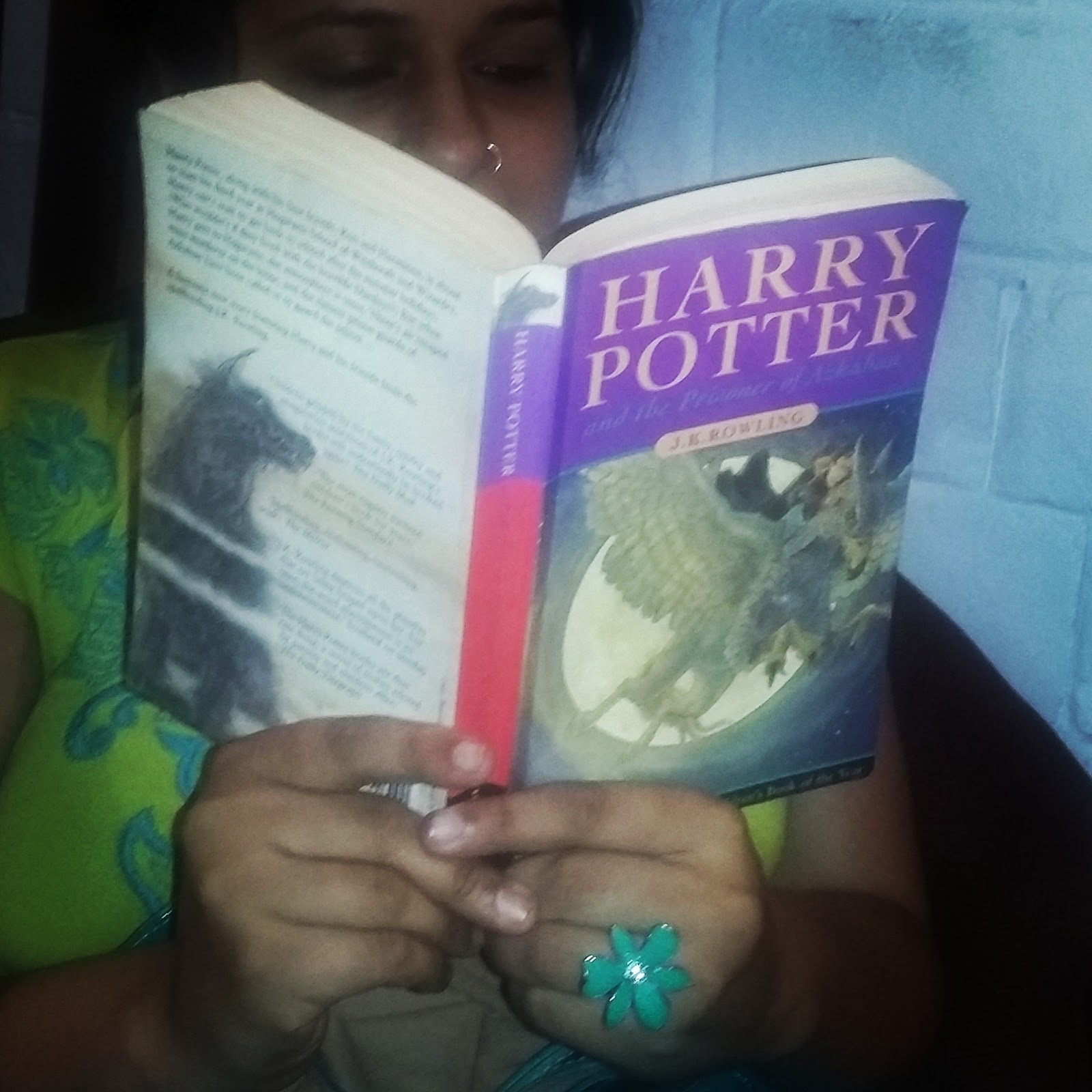
4. Harry Potter and the Prisoner of Azkaban by J. K. Rowling
Bought the entire set from Delhi Book Fair 2014. Just like that. Because I am crazy when I have money.
I cannot potentially dare to say anything about this saga - way too many Potterheads out there to glorify the series. However, I can safely say that I am ecstatic I began on this magical journey, even if very late in life.
5. The City of Djinns by William Dalrymple
Someone gifted this to me. Can't remember who.
Classic. It is not a leisurely read, but has a lot to offer to anyone who is in love with the city.

6. First There Was A Woman and other stories by Marija Sres
Bought it from the Zubaan Mela, 2014.
I pick up a lot of Zubaan books, primarily to understand gender and gendered existence. And theory never helps me, stories do, This is a fantastic book with fables, legends and myths to understand how the sociological constructions of gender came about.

7. An Abundance of Katherines by John Green
Bought from Salim bhai's bookshop (New Book Land, Janpath). Best books, best rates.
This is my favourite John Green, a preference which does not find favour with many. Besides having all the elements of a quintessential John Green book, it has some mathematics and formulae aimed at defining love. Also, it has an ending which, for a change, did not leave me brooding.

8. Myth=Mithya by Devdutt Pattanaik
Bought from Salim bhai ki dukaan.
Symbolism has always fascinated me, and when I discovered infinitely fascinating symbolism in my own backyard, I was dying with delight! Pattanaik offers you an understanding of much from our traditions, rituals and culture we take for granted and refuse to acknowledge. I am all set to read this book one more time.

9. Tuesdays with Morrie by Mitch Albom
Gifted with love and a love-note by Neha Thureja. My kid.
I do not read a lot of self-help books, and this looked like one. I was, however, pleasantly surprised by the the simplicity, both, in narrative and in content. I did not learn many new lessons here, but my faith in the way I lead life got reaffirmed a great deal.

Nine more books are left to complete this list. That will happen in the next blogpost.


